

How affordable legaltech helps small and mid-sized law firms stay competitive
The legal profession is in the middle of a tech race. Not because everyone suddenly wants “more technology,” but because clients increasingly expect legal work to be faster, more predictable, and more transparent - at the same (or lower) budgets. In that landscape, large firms start with a built-in advantage: they have the capital, IT support, and buying power to roll out strong (and typically expensive) AI solutions at scale.
If that dynamic continues unchecked, the market risks a new competitive imbalance: enterprise firms become faster, cheaper, and more consistent, and smaller and mid-sized firms start losing matters they can absolutely compete on substantively. So the question isn’t whether AI will change the market. The question is who can keep up - and whether adopting legaltech becomes synonymous with “even more scale advantage for the biggest players.”
The AI race is already underway
This isn’t a distant future scenario. Clio’s 2025 context points to 78% of lawyers already using AI tools. And on the client side, expectations are becoming explicit: the Thomson Reuters Institute’s 2025 GenAI Report notes that 59% of corporate legal clients and 44% of government legal clients want their outside firms to use GenAI.
At the same time, among smaller players, “using AI” often still isn’t the same as “using it broadly.” Clio reports that 72% of solos and 67% of small firms use AI “in some capacity,” but only 8% (solos) and 4% (small firms) have adopted AI widely or universally.
Why large firms pull ahead faster
Large firms don’t win on budget alone - they win because they can embed AI structurally. Their edge comes from implementation capacity, standardization, governance, and training. When AI is truly anchored in processes (know-how, templates, review flows), the result isn’t just speedit - ’s scale: more matters handled with less friction.
What this means for small and mid-sized firms
For small and mid-sized firms, two risks show up quickly:
- Price pressure: if a firm can move faster through the “standard” parts of a matter, it can price more aggressively - or offer fixed fees with less risk.
- Speed perception: clients increasingly compare responsiveness and turnaround time. The firm that produces a clear first analysis, chronology, or draft faster sets the tone—even if final substantive quality ends up comparable.
The paradox is that smaller firms often have exactly the expertise, flexibility, and specialization to deliver top-tier work. What can be missing is the infrastructure to deliver that work just as quickly and consistently as an enterprise player.
Why the “Swiss army knife” AI tool often isn’t the answer
Many expensive, broad AI solutions are designed as all-in-one systems. Attractive on paper. In reality, small and mid-sized firms typically hit three walls:
- Cost and unpredictable ROI: high license fees plus implementation overhead.
- Overkill: most value sits in a few core flows (analysis, research, drafting) - the rest can distract.
- Adoption drag: the broader the suite, the greater the risk of fragmented usage without a clear team standard.
That’s why the market often shows experimentation - but not enough structural embedding.
The “equalizer”: affordable, focused legaltech for the mid-market
The alternative isn’t a “cheap version of enterprise AI.” It’s high-quality legaltech built around the reality of small and mid-sized firms.
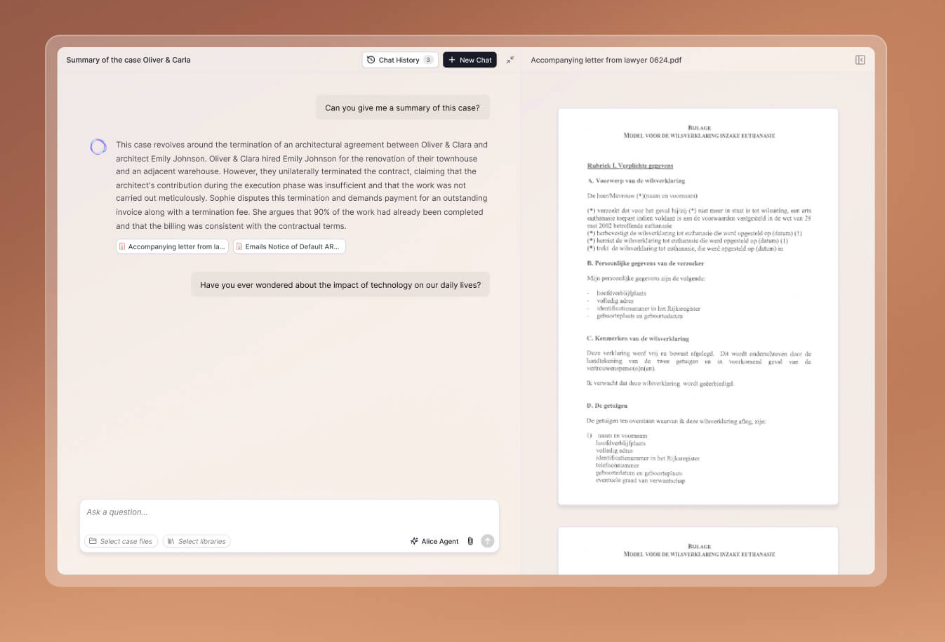
A mid-market solution should primarily be low-friction: case-file-oriented where it makes sense, with output you can verify, embedded in a simple flow from analysis to draft, without forcing a firm to overhaul how it already works - and with predictable per-user pricing.
The point of affordable, focused legaltech isn’t to turn smaller and mid-sized firms into “enterprise” firms. The point is to keep them competitive in matters where they can absolutely compete on substance. If core efficiency in analysis, research, and drafting becomes accessible, smaller firms can deliver faster, work more consistently, and offer more predictable pricing. That keeps expertise as the differentiator - and prevents firms from being priced out or overtaken simply because they don’t have the same tech infrastructure.
What changes in practice?
When AI infrastructure becomes genuinely accessible, competitiveness shifts in five concrete ways:
- Faster to a strong first version
Chronologies, positions summaries, and a first structure for a letter or brief: ready sooner, reviewable sooner. - More matters with the same team
Not just “time saved,” but capacity unlocked: take on more clients - or more complex work. - Stronger fixed-fee positioning
Fixed fees become easier to manage because the risk of “runover” drops and output becomes more repeatable. - Specialization becomes a turbo
Specialist firms can operationalize know-how into repeatable formats - without rewriting from scratch each time. - Talent and job satisfaction
Less repetitive baseline work, more focus on strategy, argumentation, and client advice.
Closing: tech as the democratization of competitiveness
If AI is mostly accessible to those who already have scale and capital, legaltech becomes a differentiator that pulls the market further apart. But as soon as legaltech becomes truly accessible for small and mid-sized firms - right price, right workflow, and verifiable output - it can start to level.
Not because every firm becomes identical, but because competitiveness remains achievable: faster delivery, more consistent output, and the same professional client experience - without being trapped by enterprise cost or complexity.


Meet a new way of working with AI
By lawyers, for lawyers
*We don't accept generic providers like Gmail or Yahoo.
