


Artificial intelligence dominates the conversation within the legal profession today more than ever. Rightly so. Its possibilities are impressive. A good AI tool can structure complex information in seconds, process large volumes of text, generate drafts and suggest lines of reasoning that used to take far more time.
But the future does not lie in technology alone. It also lies in proper internal knowledge management.
AI is not legal knowledge in itself
AI is not, in itself, legal knowledge. Nor is it legal judgment. Its added value does not lie in an illusion of autonomy, but in the quality of the substantive foundation on which it can rely. In legal matters, that foundation is never abstract: it is formed by the specific facts, the correct legal reference points and the connection between both.
That is exactly where context becomes decisive. The true value of AI only emerges when the system is correctly anchored in the relevant factual circumstances and the applicable legal framework. It is not form alone that matters, but the substantive foundation within which that form acquires meaning. A model can perfectly structure written submissions or draft an advice, but without that foundation the output quickly becomes too general, too superficial or insufficiently tailored to the case.
That legal context is traditionally provided by legislation, case law and legal doctrine. That remains the core. But in practice, the legal playing field is broader than that. Previous written submissions, letters, legal opinions, memoranda and internal analyses on similar matters also constitute a valuable source of legal intelligence. Not as evidence, of course, but as a knowledge layer. They show how a firm reasons, where it places emphasis, which arguments have worked before, which formulations are effective and how a legal problem has already been approached in practice.
That is precisely where an underestimated richness lies within many law firms.
Although a considerable part of case law in Belgium is still hidden behind paywalls, law firms often already possess a wealth of relevant sources that they have built up over the years. Think of internal precedents, historical legal opinions, procedural documents, model documents, correspondence and developed analyses. This material often contains more practice-relevant knowledge than one might initially expect. But that knowledge is too often no longer truly used. It disappears into archive cabinets, shared drives, forgotten folder structures or personal mailboxes. Formally, it still exists. Functionally, it has often become invisible.
That is a pity. More than that: it is a missed strategic opportunity.
The role of knowledge management
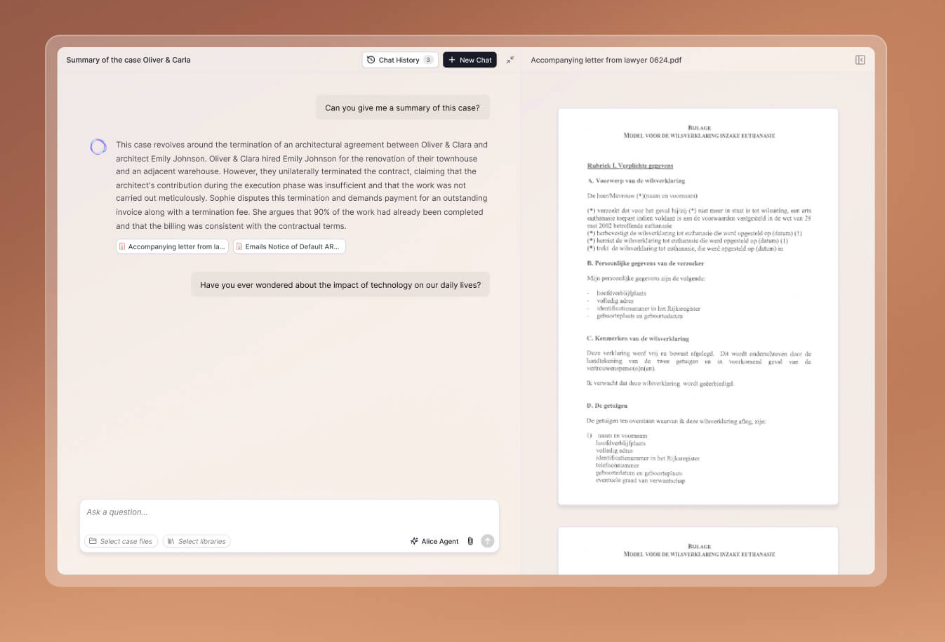
Anyone who wants to use AI in a legal practice today must therefore not only think about the quality of the tool, but also about the quality and accessibility of their own knowledge base. A high-performing AI solution can only excel when it is fed with relevant, reliable and well-managed information. The tool may be the engine, but the firm’s own data remains the fuel. Without that fuel, even the best technology runs in the void.
That is why a good AI tool matters, but good internal knowledge management matters just as much. Perhaps now more than ever. Firms that fail to unlock their internal know-how are not only leaving value on the table; they are also undermining the quality of future AI applications. Conversely, firms that organise, structure and reactivate their knowledge will be able to build a significant advantage. Not because AI will magically produce better answers, but because that AI finally has access to the right foundation.
The future of the legal profession lies in knowledge management
The future of lawyers therefore does not lie in technology alone, but in the extent to which they are able to unlock, structure and strategically deploy their own knowledge.
The future of legal AI will not be determined solely by who builds the smartest interface or generates the fastest output. It will also be determined by who understands that technology and knowledge management are not separate tracks, but two sides of the same coin.
AI changes a great deal. But one thing does not change: the quality of legal output still begins with the quality of the underlying context.
And that context is often already in-house.

Meet a new way of working with AI
By lawyers, for lawyers
*We don't accept generic providers like Gmail or Yahoo.
